
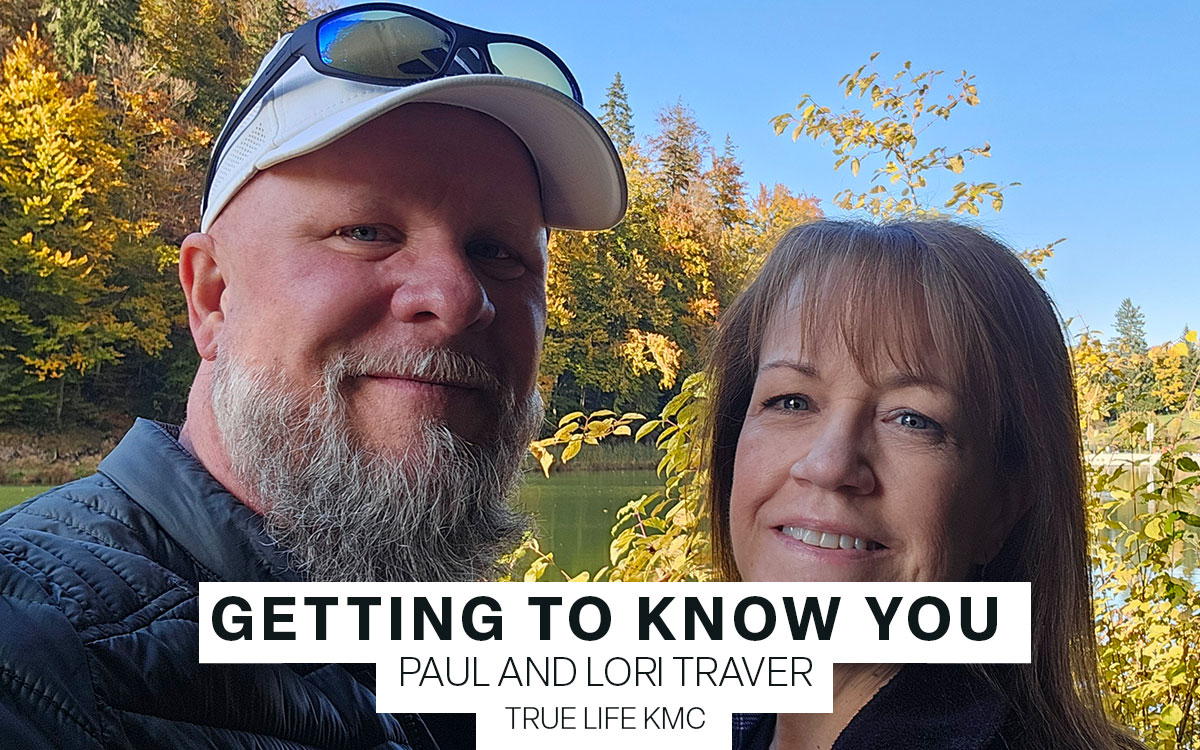
Getting to Know You: Paul and Lori Traver, True Life KMC
‘Getting to Know You’ introduces you to pastors and ministry leaders within the Fellowship of European International Church network. In this story, we feature Paul and Lori Traver, pastors of True Life KMC in Kaiserslautern, Germany.
Share a little about your life growing up: where you are from, where you went to school, and what you studied. Also tell us about your children.
I (Paul) was born in Ft. Bragg, NC. I was an Army kid whose father was a two tour Vietnam veteran, and I moved to a new duty station every three years. I eventually graduated from Capital Bible Institute in Sacramento, CA with a degree in Ministerial Arts.
Lori was born and raised in Sacramento, CA and graduated from Foothill High School in Sacramento, CA. She attended some college courses and worked for the State of California for 10 years.
We have two children, Ryan and Jordyn. Our son Ryan is 31 and has been married to his wife Ashley for 6 years. Ryan earned a degree in Criminal Justice and works in Dallas, TX for an inner-city school as an armed security officer. Ashley has a master’s degree in education and is a schoolteacher.
Our daughter, Jordyn, is 20 and is currently attending the University of Valley Forge and majoring in Family Studies with a minor in English.
Tell us about your call to ministry and what kind of work you did before you became pastors of True Life KMC.
Before full-time ministry, I worked various construction and customer service jobs. However, my call to ministry began after I graduated from Bible college. My first full-time ministry position was as a Youth/Singles Pastor at a church in Antelope, CA. Lori and I got married in 1991 and we moved to Colorado where we worked full-time and served as youth volunteers in Parker, CO. We then accepted a position as full-time lead pastor in Springfield CO. We served in Springfield for almost 10 years before being called on the mission field.
Share about your involvement with iYouth: when you got involved, how that opened a door to full-time missions and what you guys’ role is now with the camp.
Lori and I first became aware of iYouth Camp in 2003 when we attended Parker Christian Center with Dave and Donnelle Johnson. In 2009, the Lord opened the door for me to attend the camp for the first time in Gutenstein, Austria. Lori then attended her first iYouth camp in 2012. It was during the iYouth Camp in 2013 that we felt the call to missions confirmed. The Lord had been stirring our hearts to that point, but we didn’t know for sure until then that the Lord was calling us into missions. We have been serving since 2017 in Germany ministering to U.S. Military personnel and their families stationed overseas. We are still very involved in iYouth. I serve as camp pastor and Lori serves as camp admin.
Why is iYouth Camp important?
It is unlike any youth camp I have been a part of in my years of ministry. My first time at iYouth, I remember speaking in my first chapel. There I was, in a packed room of students from different nations. The Lord revealed to me that he has called us to the nations, but here he brought the nations to us. There is something about interacting with young people from a different country and realizing that you both serve the same God and have more in common than you think. If I were to sum this up: iYouth Camp is probably one of the best ministries for promoting a missions mindset to students in high school and middle school.
Tell us about True Life KMC: how old is the church, who is your focus and what the church is like in terms of nations represented and ministries.
True Life KMC Church has been active in the Kaiserslautern Military Community (KMC) since 1968. The church was started by AGWM missionaries Eddie and Ruth Washington as a small outreach to U.S. Military personnel. It has grown through the years to become a multigenerational, international church ministering to military families and internationals living in the area. Our church provides these military families with a church home away from home, with Royal Ranger, Girls Club, Youth, Worship, Men’s group, Women’s Ministries and weekly prayer and bible studies.
What makes a military church different/unique from other international churches? What are the unique needs of those in the military?
A military church is a hybrid community—military in heart, international in setting, and often missionary in vision. It supports the spiritual and emotional needs of U.S. service members and families in ways that are more flexible and community-driven than traditional military chapels, while also embracing a broader international audience and ministry scope.
The needs of military members overseas go beyond basic church attendance—they need intentional community, soul care, biblical guidance, and ministry structures that understand the realities of military life and the stresses of foreign assignments. These men and women live at the crossroads of service, sacrifice, and spiritual hunger, often in contexts where typical church support is unavailable or insufficient.
What do you enjoy about ministering to members of the military and their families?
Although I didn’t serve in the military myself, I was an ‘Army Brat’. I understand the stresses of military life on families. Ministering to members of the military and their families is deeply rewarding, both spiritually and relationally. They live with the reality of sacrifice—time apart, constant relocations, risk, and emotional strain. Ministering to people who live that out day-to-day brings a profound sense of purpose.
Also, because military life is so transient, people tend to be open, honest, and quick to connect. There’s little time for shallow relationships. That creates fertile ground for deep conversations, mentoring, and spiritual growth.
What is it like to live in an area of Europe that has thousands of Americans in a small community?
Living near a major U.S. military base in Europe creates a unique, semi-globalized environment. For locals, it brings economic opportunities and cultural mixing—but sometimes tension. For Americans, it’s a blend of familiarity and foreignness—an opportunity to experience Europe, but often from within a protective bubble.
Currently we have around 50,000 service personnel in the Kaiserslautern/Ramstein area. It will fluctuate depending on need. This includes active duty, their families, and civil service/contracted personnel. The Kaiserslautern Military Community (KMC) includes approximately 30 U.S. military sites and facilities across the region.
Is there anything you guys have learned from serving at True Life KMC that you think would help other international churches who have military members in their churches?
Yes, be patient, love quickly, give people opportunities to serve, and be ready to let them go. Military families oftentimes don’t have years for you to trust them or develop their leadership skills. They are on the move, all the time. Learn to hold on to them lightly, since they will be moving, but also learn to love them quickly…they are good people. Loyalty, resiliency, faithfulness, authenticity, and order are things they are drawn to.
Describe some of the ministries in which the church is involved/active.
What do you see as some of the most pressing challenges of military churches in Europe? Also, do you know how many AG military churches there are in Europe?
Military churches in Europe face a unique set of challenges that blend the complexities of military life, transient communities, cross-cultural environments, and the increasing secularization of both Europe and the U.S. military population. These churches often serve dual roles—as spiritual homes and as community hubs—and that makes their challenges even more nuanced. We currently have 4 AGWM Military Ministries churches in Europe (Kaiserslautern, Stuttgart, and Grafenwoehr in Germany and Naples, Italy).
How can fellow FEIC member pastors pray for you guys?
It is very challenging serving in an ever-changing church population. It is hard to let our people go after just a short time of loving them. Pray for our spiritual, emotional, and physical well-being both as a couple and individually. It is also tough having our children and families so far away.
Anything else you’d like to share?
Lori and I have lived here in Germany, serving at True Life since June 2017. We want to see a reviving of faith, and a restoring of hope in our military community, and our church. A good old-fashioned revival would be deeply welcomed.
