
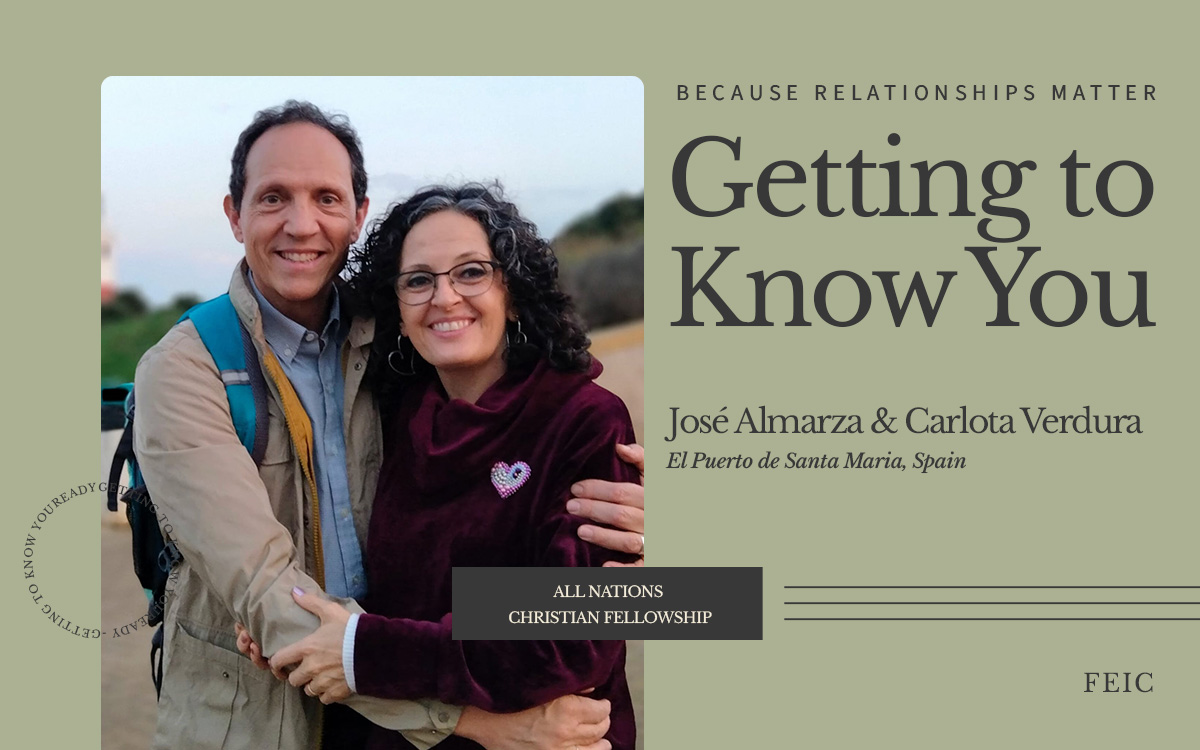
Getting to Know You: José Almarza and Carlota Verdura
‘Getting to Know You’ introduces you to pastors and ministry leaders within the Fellowship of European International Church network. In this piece, we feature José Almarza and Carlota Verdura, who lead All Nations Christian Fellowship in El Puerto de Santa María, Cádiz, Spain. With José’s roots in the heart of La Mancha and Carlota’s decades of missionary service across Europe, they lead a vibrant, multilingual congregation of some 15 nations.
Where are you originally from?
José: I am originally from La Mancha, Spain, most precisely from Villanueva de Los Infantes, The Quijote’s hometown.
Carlota: I’m from Mexico City. I’ve been serving in Spain as a missionary since 1989.
Tell me about your education.
José: I hold four degrees: Theology (in the USA), Linguistics (in France), Teaching and Translation-Interpretation (in Spain). I am also an official legal translator-interpreter English-Spanish. I am now trying to finish my master’s in theology at the School of Theology of the Assemblies of God of Spain.
Carlota: I studied up to 12th grade, went to a 2-year Bible school in Mexico and 1 in Germany. I’m fluent in Spanish, French, German and Italian.
Where did you serve in ministry before coming to your current location?
José: I served in my hometown’s church where I became a Christian, in Mexico one year, in Kenya one year, and in other parts of Spain supporting pastors at local churches while working basically the rest of the time.
Carlota: Madrid.
How and when did God lead you to the country where you now serve?
José: Carlota and I were living in Madrid by the time we received the challenge to become pastors of this international church in southern Spain back in November 2012. We prayed about it and spoke with AG representatives. Carlota had worked at the International Church of Barcelona for 8 years, so the pastors there back then (Dan and Kathy Stump) encouraged and backed us up so that we would become pastors of this church at El Puerto de Santa María, Cádiz, which had not had permanent pastors for more than two years. That was and is so far our first and only experience as lead pastors of a congregation.
Carlota: I was 21 studying in Bible school and travelled to Europe with a backpack. While here I visited some missionaries and as I was returning home, I felt God calling me to be a missionary. So, I prayed for missionary needs some of which were in Spain. One day praying for the need for someone to lead the children’s ministry, I said: “Here I am Lord, send me!” When I realized what I had said I asked God for confirmation: that my unbelieving parents and my pastors (who said missionary is not a word in the Bible) would agree…and they did!
Tell us about the makeup of your church. Do you know how many nations are represented?
José: The turnover of the church is huge every year. But currently the church is composed of both Spanish people and foreigners. The church is very close to the Naval Rota Base, so we have that strategic contact with American naval people and families, and the chapel inside the base. Other nationalities represented, apart from American and Spanish, are British, Colombian, Equatorian, Dutch, Chilian, Venezuelan, Mexican, Philippine, Ukrainian, German, Bolivian, Peruvian, Tanzanian, Saharawi, Puerto Rican… and visitors from many other countries.
Carlota: Our church, as most international churches, has a different face each season depending on the nationalities and people. But I would say that the people are welcoming and open which breeds that in the new ones, so there’s a feeling of family and home, for which we are very grateful. We usually have around 15 nationalities.
Would you say that All Nations is more Spanish than English/International and if so, how does that influence the international nature or culture of the church?
José: At this moment the number of Spanish amounts to about half of the church. But we do bilingual services with consecutive interpretation. This makes the church attractive to the people that also want to learn languages, but non-attractive to people that don’t like the constant interruptions of interpretation.
Nevertheless, although this church is not comparable to the International Churches of Barcelona and Madrid because this is a small town and located in the area of Spain with highest unemployment rate, the nature and the culture of the church is still international. Ah, also in spite of the fact that one of the pastors is Spanish.
Describe some of the ministries in which the church is active.
José: Homeless outreach, prison ministry, hospital ministry, discipleship, home groups, worship, preaching and pastoring. Also, we are involved in fraternities and activities with other churches in the area.
Carlota: In addition to what Jose wrote, we support a different mission every month, some of them are local, national and international.
What makes your city unique in terms of culture, international atmosphere, and Christian impact?
José: Apart from what I mentioned before, ANCF is a family church with very few people in full-time ministry (only Angela, Carlota and myself), so part of the uniqueness of the church atmosphere is its small size and the obvious challenge that, if you want to join, you are probably going to have to help and get involved.
What attracted you to international church ministry?
José: I didn’t feel attracted to this ministry, but God, in His wisdom, led us in this way. But it is also true that I love languages and getting to know people from diverse nations.
Carlota: The fact that I have lived in several countries and speak the languages, plus I served at ICB for 8 years.
What do you see as some of the most pressing challenges of the church in your country?
José: Spain needs a spiritual revival. During the last decades, most of the people that have joined the Evangelical churches are immigrants coming from Latin America. Denomination divides and mistrusts don’t help either. Apart from the power and encouragement of the Holy Spirit, we also need wisdom and strategic creativity in order to reach the Spaniards in ways that are more apt to the current Spanish mentality, and not to the American or Latino American mentalities. We need more local pastors and evangelists.
What challenges do you face personally as pastors of an international church?
José: Apart from the aforementioned constant turnover, we are facing the challenges that have to do with the fact of getting older, and also having to deal, pray and include people coming from diverse denominations and Christian families. Also, the feeling of being mediocre for not speaking perfect English and for not being a natural born leader.
Carlota: It’s hard to have a stable community and team.
What have you learned about international church ministry while serving?
José: I have learnt how to survive and keep serving in the midst of chaos, opposition and loneliness. I have learnt to stay focused on the international church needs and nature, but also open and active in the needs of the society where we are, and in relation with the rest of the churches in the area.
Carlota: That it’s very enriching and a piece of Heaven on earth.
What do you find fulfilling about serving at your church?
José: Working alongside my wife Carlota, celebrating the little miracles and progressive transformations that we see here and there with people that stay, and especially people that leave. When we deal with people that are honestly open and thankful to be helped and ministered (for instance at the prison or the refugees). Particularly, the sense of relief every Sunday after the service has finished, we have said goodbye to the remaining people and closed the church’s door. In spite of the fulfilling things, I must say that sometimes I feel tired and ready for another type of experience… after more than 13 years here!
Carlota: The multicultural, multigenerational elements are precious and keep us alive and moving constantly.
What kind of value does the FEIC network bring to church pastors like yourselves?
José: The fact of getting to know and learn from great people and sharing our challenges and experiences. Carlota and I have been ministered to and encouraged by so many FEIC people during these years! By the way, sometimes I have felt a little bit out of place for not being American.
Carlota: The friendship, to be able to talk about the same issues and know you are not alone.
How can fellow FEIC pastors pray for you?
José: Wisdom, healing and grace to face the medical issues that we are both currently encountering. Spiritual direction and power to really lead the congregation, and to survive. That the Lord would send or raise in the congregation more people willing to be trained and involved in ministry. For provision, wisdom and direction concerning the passing of the baton to new pastors at the right time. Also, please, to finish the master’s well.
Carlota: For guidance, laborers and for the next pastor God has for All Nations.
